Plan the transition on your terms
Set retirement timing for each partner and connect it to the income and spending that change when work ends.
Retirement planning
Connect what you’re saving today with the life you want after work. Explore retirement dates, account choices, and the income that carries you forward.
See what’s possible
Try a retirement date, examine the years your savings need to cover, and test how a different finish line changes the plan.
Read the detailed guideSet retirement timing for each partner and connect it to the income and spending that change when work ends.
Model contributions, employer matches, taxable investments, and retirement accounts as parts of one lifetime picture.
Include Social Security, pensions, withdrawals, and required distributions. Model health coverage before and after Medicare, including estimated marketplace subsidies and income-related premiums.
Explore the details
The move out of work can change health costs as well as income. Marketplace coverage, Medicare, and supplemental costs have different timing and assumptions. Keeping these in the forecast helps you investigate the years before 65 and the effect that earlier income can have on later premiums.
From a question to a clearer picture
Retirement planning brings account contributions, the end of earned income, later benefits, and the cost of living onto one timeline for the household.
Enter household ages, retirement timing, and the horizon you want to explore. Add the income streams that stop, continue, or begin as each person moves out of work.
Enter account balances and tax treatment, then configure contributions and employer matching where applicable. Review the contribution schedule alongside the income that needs to support it.
Inspect cash flow around retirement, when benefits start, and when required distributions appear. Include the plan’s health-cover assumptions before comparing the account balances left for later years.
Connect the whole plan
Retirement can change the household from adding to accounts to drawing from them. The withdrawal chart shows when each source enters the picture and how much it supplies. Read the shift from brokerage balances to retirement accounts alongside the plan’s tax view and later required distributions.
One way to use it · illustrative scenario
Imagine a household where one partner wants to retire at 60 and the other expects to keep working until 65.
Try an example planThey set separate retirement dates, review which contributions continue, and give Social Security and pension income their own start dates.
They compare the years with one salary against the years with no salary. Cash flow shows when withdrawals enter the picture, while account and tax views show which balances provide them.
The comparison makes a staggered retirement visible year by year, including the years between each person’s last paycheck and the start of their retirement benefits.
Make sense of what you see
The account settings distinguish money you put in from the employer match. Their effect belongs in the whole forecast, where household cash also covers taxes and living expenses.
A contribution that increases with inflation follows a different path from a fixed dollar amount. Check that choice before interpreting a rising contribution total as a change in saving effort.
Taxable, tax-deferred, and Roth accounts do not produce the same withdrawal and tax pattern. Read their separate balances and the later distribution schedule, rather than treating every retirement dollar alike.
A little more detail
Yes. Retirement timing and a Social Security stream’s claiming age are separate choices. The plan can therefore show a period after wages stop but before benefits begin. Benefit estimates follow the inputs and rules the model supports.
Health cover settings include modeled marketplace coverage before 65 and Medicare afterward, with estimated subsidies and income-related premiums where applicable. These costs belong in the projection; the app does not enroll you in coverage or choose a policy.
The model applies supported contribution limits, catch-up rules, and phaseouts according to account type and household inputs. Its annual projections do not replace account records or establish personal eligibility. The contribution guide explains the rules and boundaries being modeled.
Keep exploring
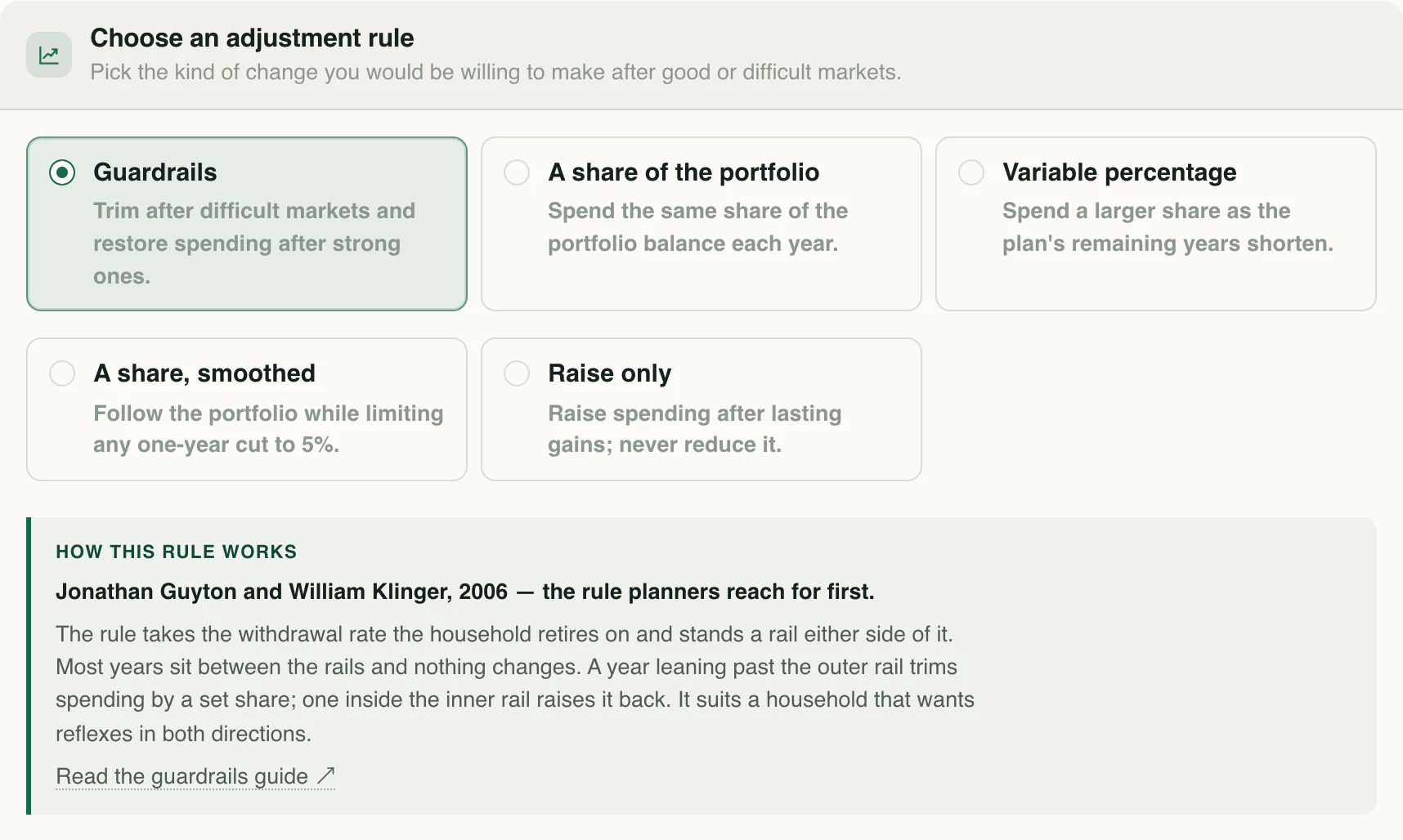
Compare retirement withdrawal strategies, including guardrails and variable percentage withdrawals, and see how spending responds to your portfolio.
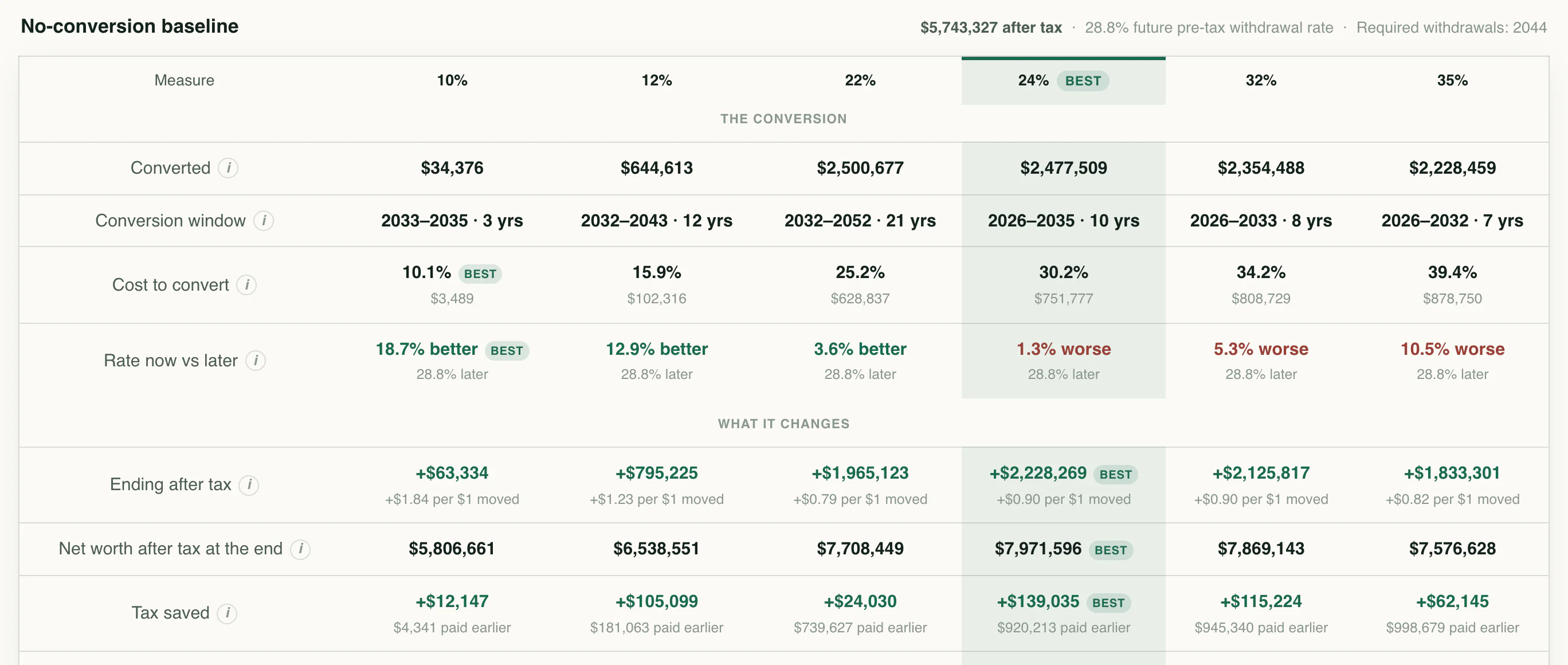
Compare conversion strategies and see the trade-offs between taxes today, later withdrawals, and ending wealth.
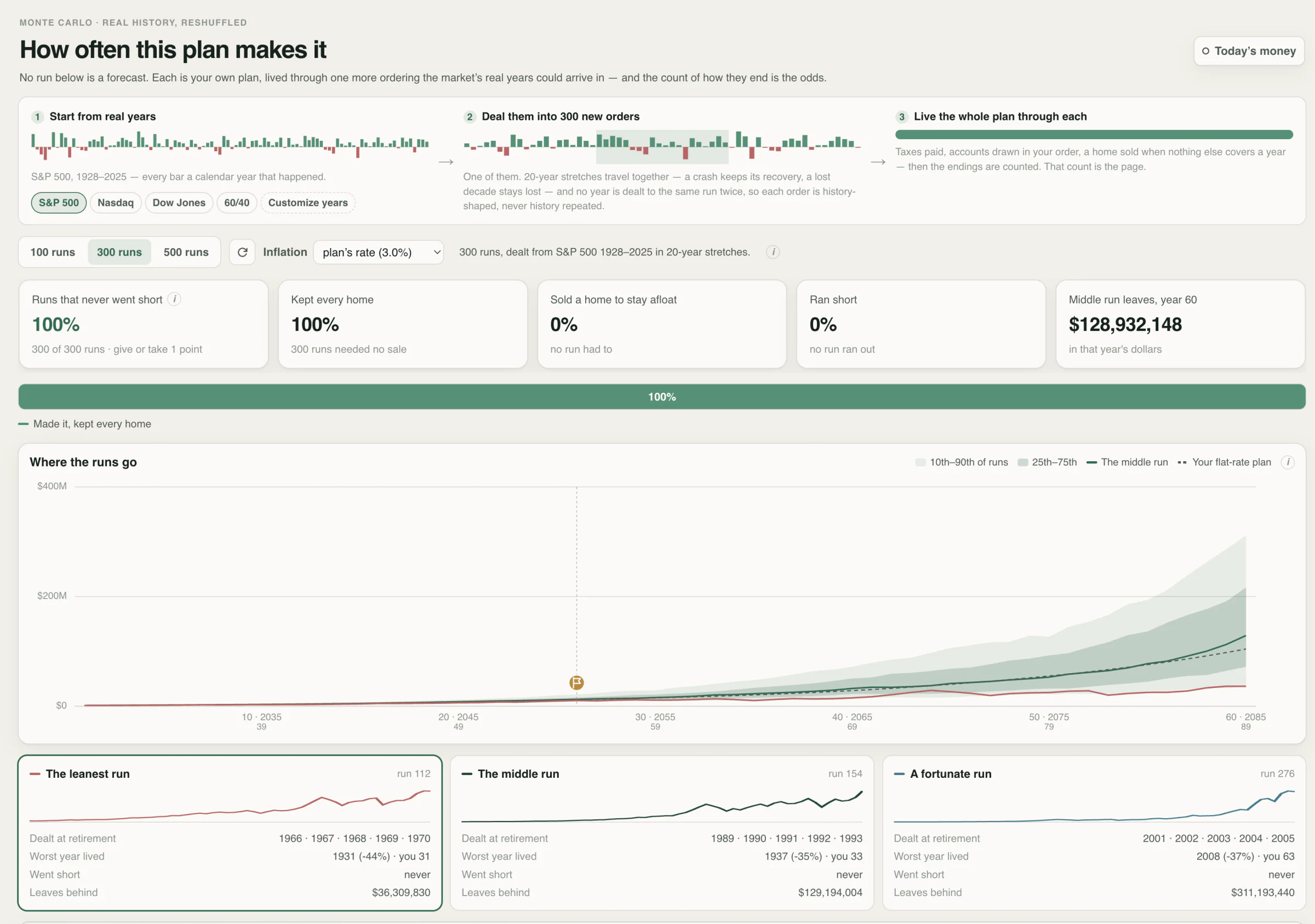
Stress-test your financial plan with historical market sequences and explore a range of possible outcomes.
Know the language
Your next chapter
Start with your numbers. See where they could lead.