Choose your definition of better
Explore outcomes such as net worth, estate value, tax efficiency, and after-tax spending.
Strategy Lab
Let Strategy Lab test combinations of changes against the outcome you care about. Understand the moves behind a result before trying them in your plan.
See what’s possible
Define what matters and which choices are open for exploration, then compare the candidate paths the search finds.
Read the detailed guideExplore outcomes such as net worth, estate value, tax efficiency, and after-tax spending.
Choose which saving, spending, property, investment, and tax decisions may change. Major lifestyle changes begin switched off.
Inspect the candidate’s changes and impact, then try the path in What-If before committing it to the plan.
Explore the details
An improved ending balance may involve a different budget along the way. The spending view helps translate a candidate strategy into the years and commitments it affects. Before applying a combination, examine what happens to housing, family costs, healthcare, and the expenses you intended to make flexible.
From a question to a clearer picture
Strategy Lab reruns the plan across allowed changes, then compares moves and compatible combinations against your chosen outcome.
Choose net worth, after-tax money to spend, estate value, or tax efficiency. Review the allowed levers before running. Spending cuts, primary-home sales, relocation, and retirement timing require you to include them explicitly; their real-life assumptions still matter.
Start with Standard or choose Thorough or Exhaustive to explore a broader set of candidates. Run the search and read its status. If you change the goal, plan, or boundaries, update the results so the comparison answers the question you are currently asking.
Read the candidate's moves, modeled impacts, and What to check first details. Compare the other measures as well as the selected goal. Try a candidate in What-If to examine the resulting projection before choosing whether to keep the changes.
Connect the whole plan
Saving, withdrawal, and tax choices can influence one another. When a candidate includes conversion decisions, dedicated tax planning provides another way to inspect the cost and the projected benefit. Use those details to understand why a move helps the combined plan and whether its assumptions fit your question.
One way to use it · illustrative scenario
Imagine a household with spare annual cash and several types of investment accounts. It wants to explore changes without moving home or altering retirement timing.
Try an example planKeep those lifestyle levers off, allow relevant saving and withdrawal choices, and run a hypothetical net-worth search.
If the search finds a candidate, read how each move changes the plan alone and within the combination. Check taxes, estate value, and any constraints alongside the selected goal.
Compatible moves can overlap or reinforce one another. The combined result must come from a full-plan comparison rather than adding the largest isolated gains.
Make sense of what you see
The candidate's prominent figure describes improvement in the chosen goal. Nearby net-worth, estate, and tax measures reveal other effects. Check whether amounts are changes from the baseline and whether today's money is selected before comparing them elsewhere.
Where available, the path shows a move on its own, its added effect given the other moves, and a running total. These readings explain why the combination can differ from the sum of individually priced actions.
Account ownership, contribution assumptions, withdrawal order, and What to check first details identify what the candidate actually changes. Review the ledger as well as the leading card to see which decisions were priced and which alternatives deserve attention.
A little more detail
It is the best candidate found within the selected choices, assumptions, and search budget. Deeper searches examine more possibilities but do not establish a global optimum. Retirement timing is shown as a separate sensitivity rather than combined into a recommended path.
The tax goal uses modeled safeguards against materially reducing after-tax wealth or making the plan run short sooner. The after-tax-spending goal considers funded spending plus ending after-tax wealth, so a candidate cannot win that goal simply by cutting spending.
Running it produces candidate results. Trying a path opens a What-If comparison so you can inspect its effects before keeping it. Results based on earlier inputs must be updated before applying them to the current plan.
Keep exploring
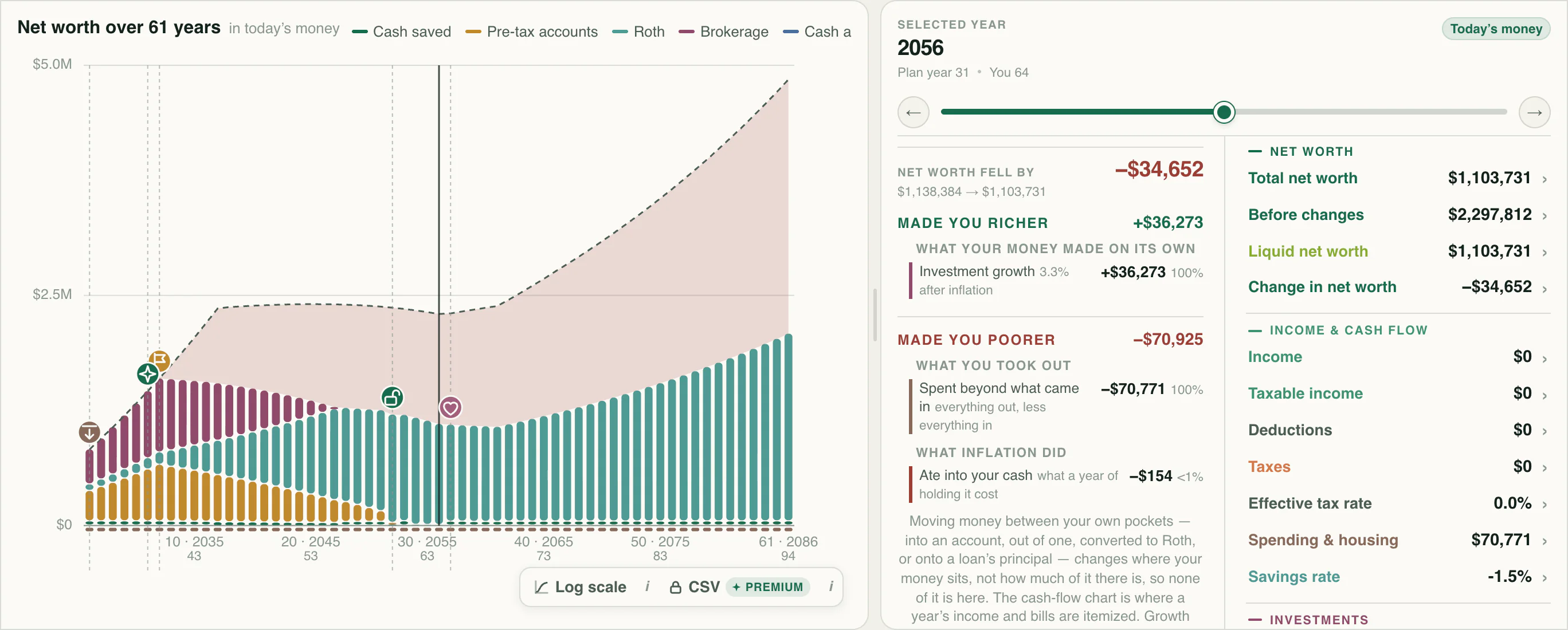
Compare financial planning scenarios for retirement dates, saving rates, career changes, and home purchases against your original forecast.
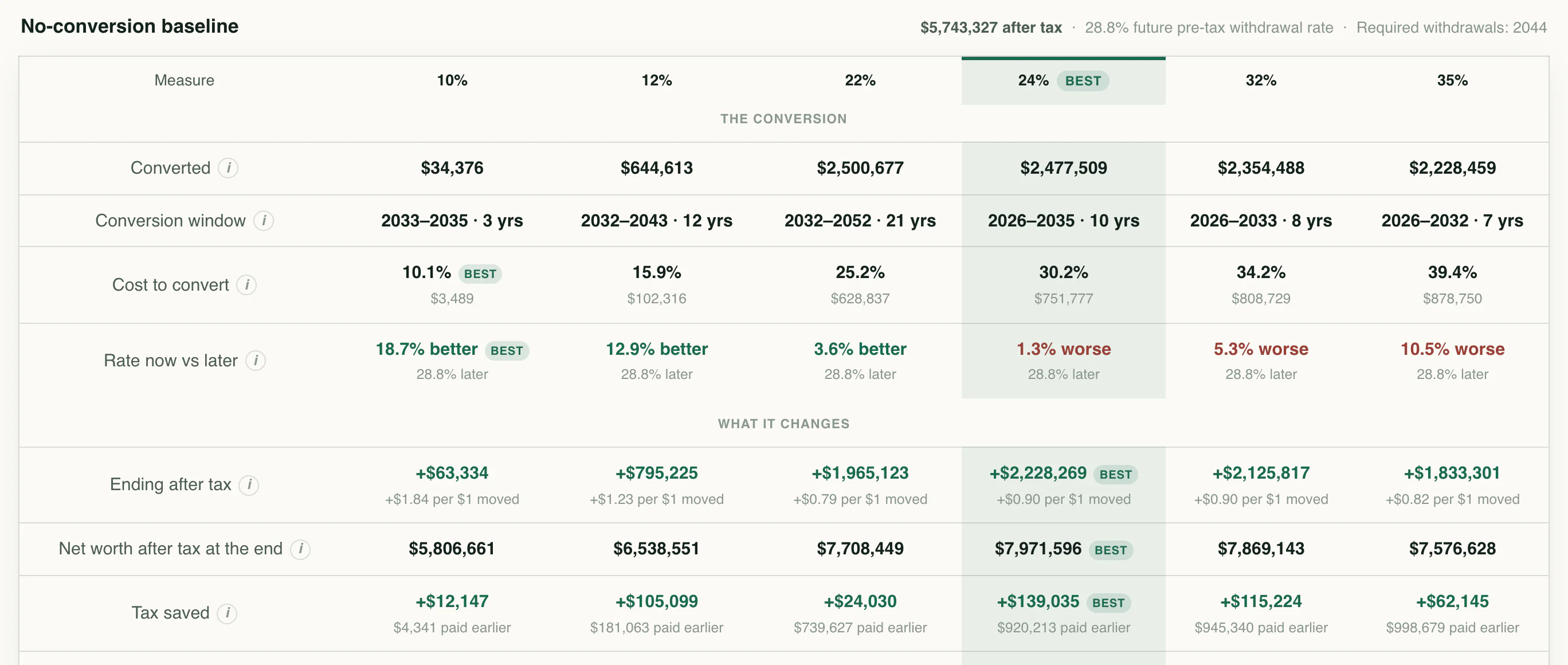
Compare conversion strategies and see the trade-offs between taxes today, later withdrawals, and ending wealth.
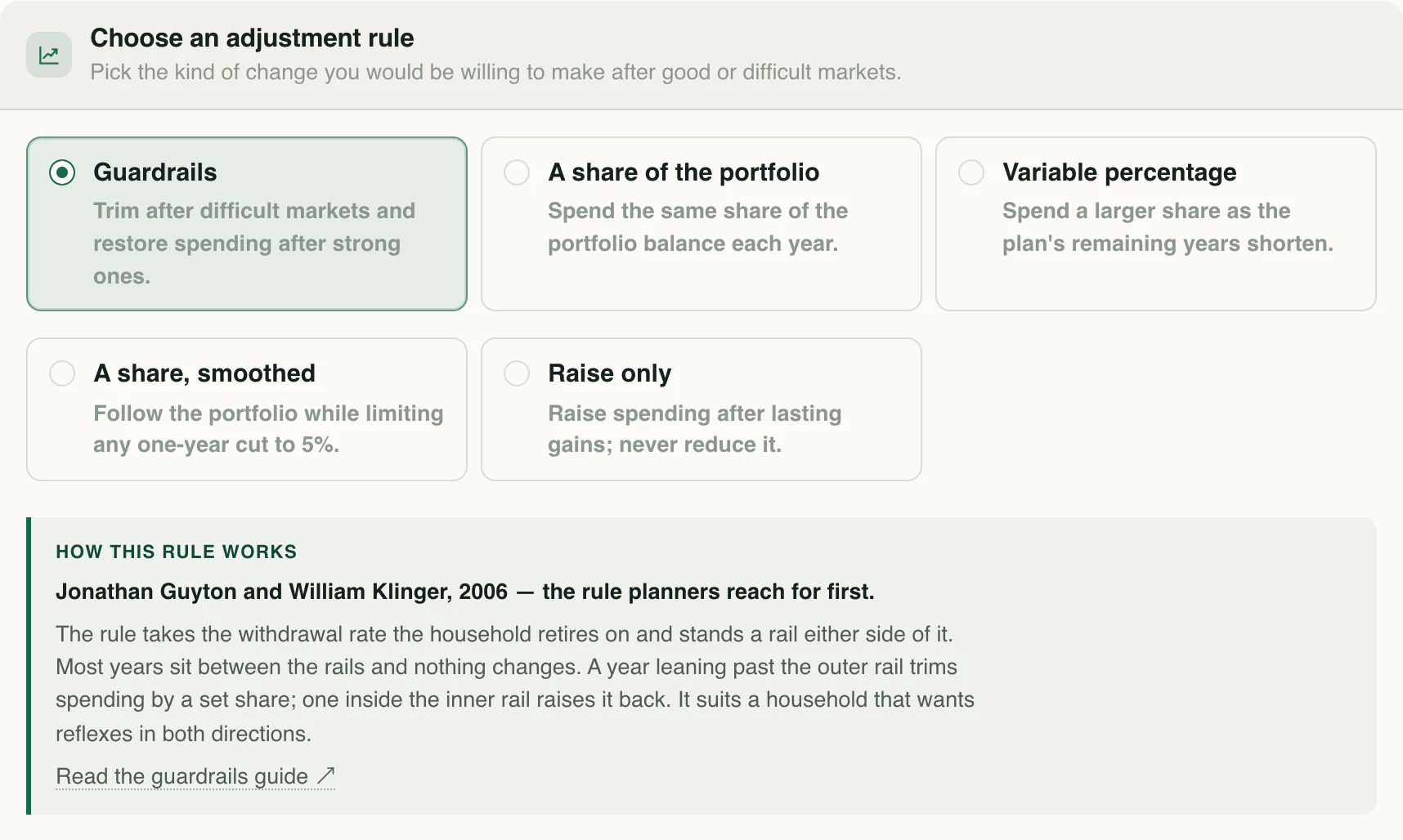
Compare retirement withdrawal strategies, including guardrails and variable percentage withdrawals, and see how spending responds to your portfolio.
Know the language
Your next chapter
Start with your numbers. See where they could lead.