Compare three federal gains brackets
Explore 0%, 15%, and 20% targets side by side, including cost basis raised, tax paid, lifetime tax differences, and ending net worth.
Capital gains harvesting
Explore realizing investment gains in years with lower tax rates. See how raising cost basis today could change taxes when you sell later.
See what’s possible
Compare harvesting strategies after the applied Roth schedule, then inspect the costs and potential benefits through the rest of the plan.
Read the detailed guideExplore 0%, 15%, and 20% targets side by side, including cost basis raised, tax paid, lifetime tax differences, and ending net worth.
Select eligible brokerage accounts, a date window, an annual gain cap, and a guardrail against adding the net investment income tax.
Roth conversions run first. Inspect each year’s income stack to see the remaining gains room and why harvesting occurred or stopped.
Explore the details
An account’s balance shows how much it holds; its basis helps determine the taxable gain on a sale. The modeled sale and repurchase can raise basis while keeping the position invested. Review account balances with the harvesting analysis so a basis increase is not mistaken for newly created wealth.
From a question to a clearer picture
Gain harvesting models selling and repurchasing appreciated taxable investments, keeping their market value invested while increasing cost basis.
Open Step 2 of Tax Planning with a brokerage account that includes balance and cost basis. Enable harvesting, select the source accounts, and review when it runs. Add an annual realized-gain cap and the investment-income-tax guardrail when those boundaries belong in your scenario.
Review the 0%, 15%, and 20% federal gains targets with the other settings held fixed. Check the Roth status above the controls: an applied conversion schedule normally uses ordinary-income room first. The comparison explains whether it includes that schedule or explicitly ignores it.
Select a year in the chart to see what leaves room for a harvest and what stops it. Compare the basis increase, harvesting tax, lifetime tax differences, and ending wealth before interpreting a larger harvest as a better result.
Connect the whole plan
Both harvesting and Roth conversions use parts of the same annual income picture. A conversion can change the room available for gains, and a gains target can affect the combined strategy. Review the conversion assumptions before interpreting how much a harvesting schedule can realize in each year.
One way to use it · illustrative scenario
Imagine a household holding appreciated brokerage investments as earned income falls. It wants to explore the effect of realizing gains.
Try an example planSet a hypothetical harvesting window around those years, keep the same Roth schedule, and compare gains targets using the same account selection and cap.
Check which years actually harvest, how much basis rises, and whether income or another guardrail limits the amount. Then review the later sale years and full-plan differences.
The potential benefit depends on when the investments are sold later and their modeled tax treatment. A basis increase is not an immediate cash payout.
Make sense of what you see
The chart places ordinary income, applied Roth conversions, earlier gains, and the proposed harvest in the same annual picture. The selected bracket line provides context for why the amount fits or why little additional room remains.
The detail panel identifies the year's income, deductions, harvest, and limiting reason. Look at it when two nearby years behave differently. A no-harvest year can be informative if existing income already fills the relevant room.
A harvest raises cost basis by realizing gain while the modeled position remains invested. The tax cost and later tax effect are separate readings. Compare those with ending wealth, rather than using the harvested amount alone to rank strategies.
A little more detail
The feature uses eligible brokerage accounts and their cost basis. Retirement, cash, HSA, and education accounts do not participate. An account without embedded gain today may behave differently later, depending on the growth and sales already modeled in the plan.
No. It names a federal gains-bracket target. Other modeled taxes or income interactions can still create a cost. Read the year's tax detail and the full-plan comparison, particularly when Roth conversions or other gains occur in the same year.
No. This is an annual projection using proportional account cost basis, not a trading instruction or lot-selection tool. The modeled sale and repurchase explain a scenario; the product does not execute the transaction in an investment account.
Keep exploring
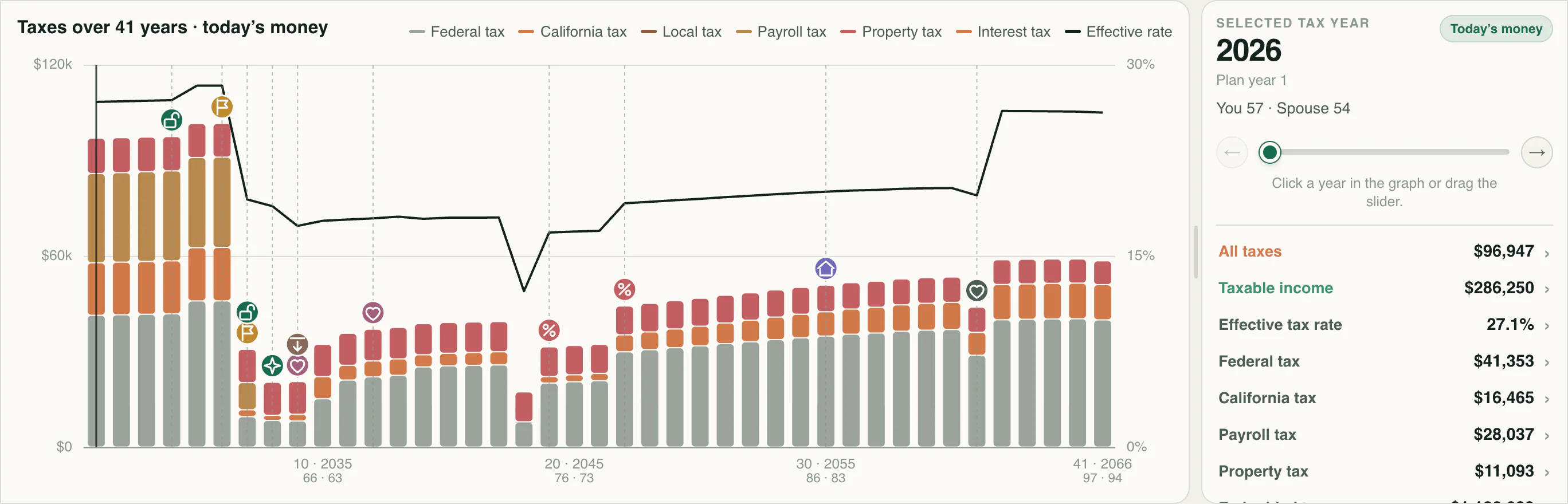
Explore estimated lifetime taxes and inspect the income, rates, and deductions behind each year.
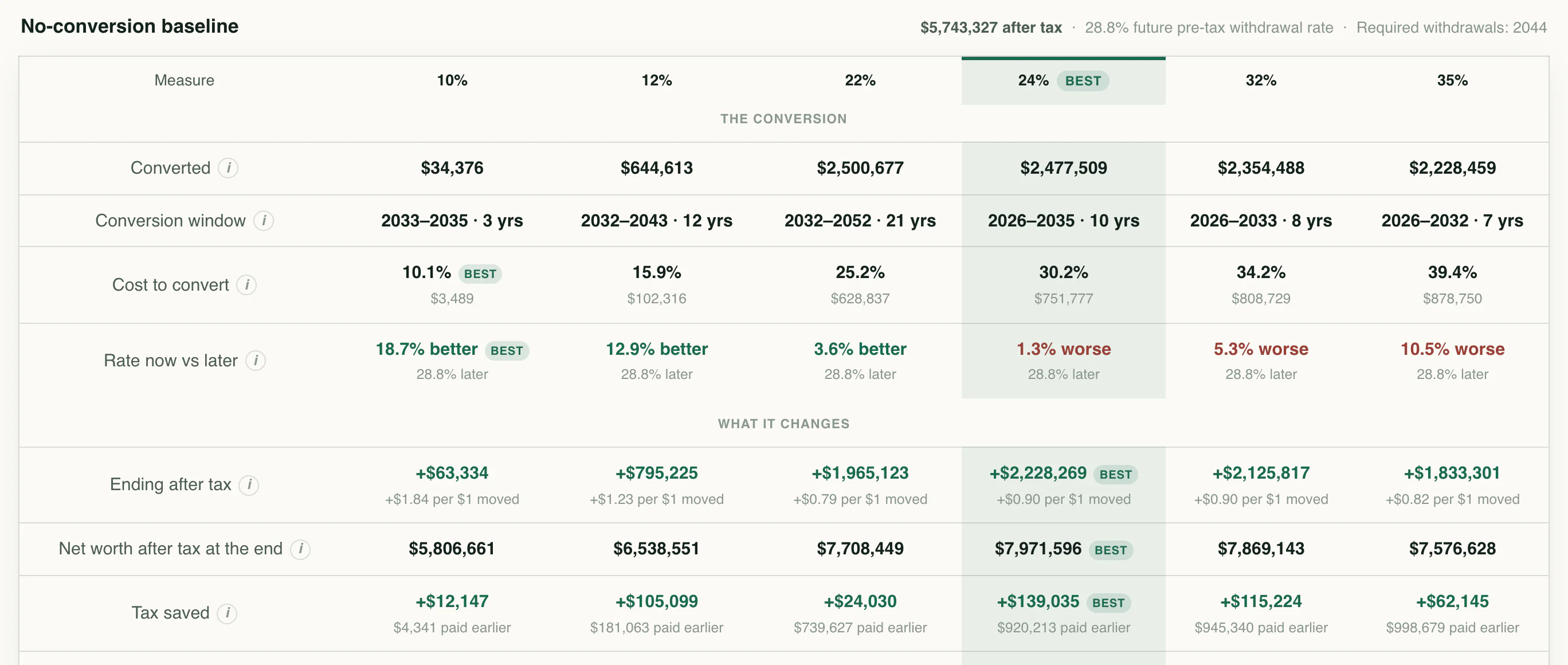
Compare conversion strategies and see the trade-offs between taxes today, later withdrawals, and ending wealth.
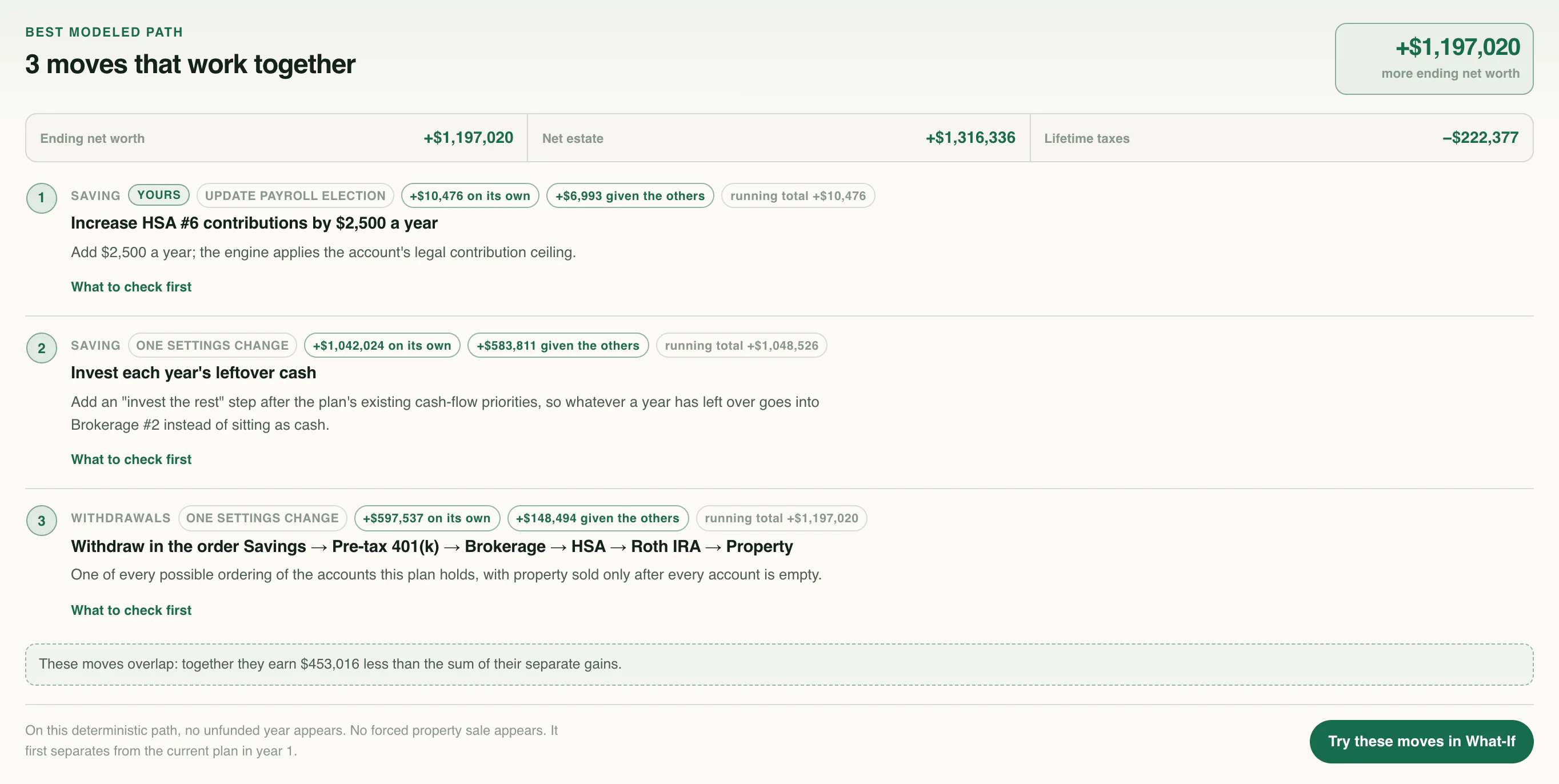
Test combinations of saving, spending, investing, property, and tax choices against the outcome you choose.
Know the language
Your next chapter
Start with your numbers. See where they could lead.