Read the plan one question at a time
Explore focused measures of savings, retirement readiness, withdrawal pressure, cash reserves, and other financial patterns.
Financial wellness
Turn your forecast into a set of clear questions about your financial life. See what looks healthy and what deserves a closer look.
See what’s possible
Start with the scorecard, choose a question that matters to you, and follow it back into the plan.
Read the detailed guideExplore focused measures of savings, retirement readiness, withdrawal pressure, cash reserves, and other financial patterns.
Filter by verdict to focus on the parts of your forecast that merit attention.
Compare before-and-after results while exploring a What-If, with each verdict grounded in the changed projection.
Explore the details
A liquidity reading becomes more useful when you can trace it to an assumption. The cash reserve setting defines how much of the household’s outgoings should remain available before surplus money moves elsewhere. Review that setting together with the wellness measures and the years when the budget becomes tighter.
From a question to a clearer picture
Wellness organizes the same forecast into focused readings of savings, retirement, income, spending, and debt.
Review balances, income, expenses, retirement timing, and debts before opening the scorecard. Each card depends on those inputs. A missing account or an unrealistic spending assumption can change several readings at once, even when the page itself contains no editable figures.
Read the summary, then filter for Strong, Progressing, or Needs attention. Within each category, open the explanation below the number. Follow an Open the page link where available to inspect the projection, taxes, estate, or resilience detail behind the card.
Explore a plan change in What-If and return to Wellness. The Changed by this what-if edit filter gathers cards whose figure or rating moved. Compare the previous reading with the new one, then examine the underlying years before deciding what to keep.
Connect the whole plan
A headline measure can hide several different life stages. Opening the spending view shows when family commitments, mortgage payments, debt, and healthcare overlap. This helps connect a wellness question to the years and expenses behind it, making the next assumption to investigate more concrete.
One way to use it · illustrative scenario
Imagine a household considering a later retirement date. It wants to see how the extra working period changes the financial picture.
Try an example planIn a hypothetical What-If, move retirement timing and review the associated income and expense dates.
Return to the scorecard and inspect changed retirement, savings, and cash-flow readings. Follow any relevant links to see whether the result comes from extra contributions, a shorter withdrawal period, or another assumption.
The value of the scorecard is the set of questions it surfaces. Different cards can move in different directions, and some may remain unchanged.
Make sense of what you see
A card's explanation identifies its time period and calculation. A savings measure covering working years, a current cash-flow figure, and an end-of-plan balance describe different parts of the forecast even when they share the same rating color.
For information and Not in this plan are distinct from the three rated states. A retirement countdown can be useful without receiving a good-or-bad verdict. An inapplicable metric is not a failed check that needs to be fixed.
Earlier financial independence and money lasting longer are different kinds of improvement. The What-If comparison shows the prior value and any rating change, helping you interpret the move instead of assuming every larger number is preferable.
A little more detail
No. It summarizes the share of rated wellness metrics classified as Strong. The separate Chance the money lasts card reads historical simulation results. Neither the summary percentage nor a green card guarantees a future outcome.
The resilience-related reading waits for its historical runs to finish. If the plan has no accounts that follow a market index, there is no simulated success rate to display. Other cards can be inapplicable because the relevant account or household feature is absent.
The numbers come from your modeled plan, while the rating thresholds are planning heuristics. Use the explanation and supporting page to understand each reading. The scorecard does not assess every personal priority or turn a threshold into a required action.
Keep exploring
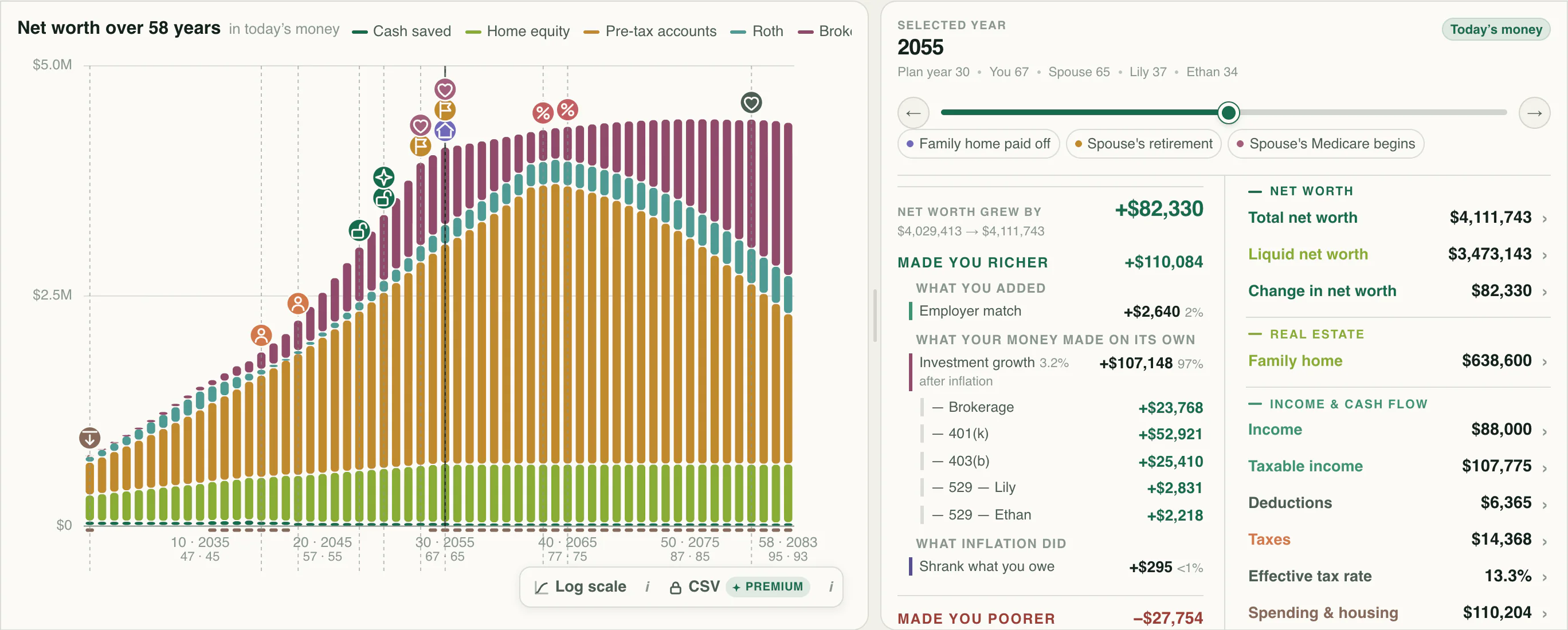
Financial planning software to project income, spending, taxes, investments, and net worth year by year, then compare the choices that shape your future.
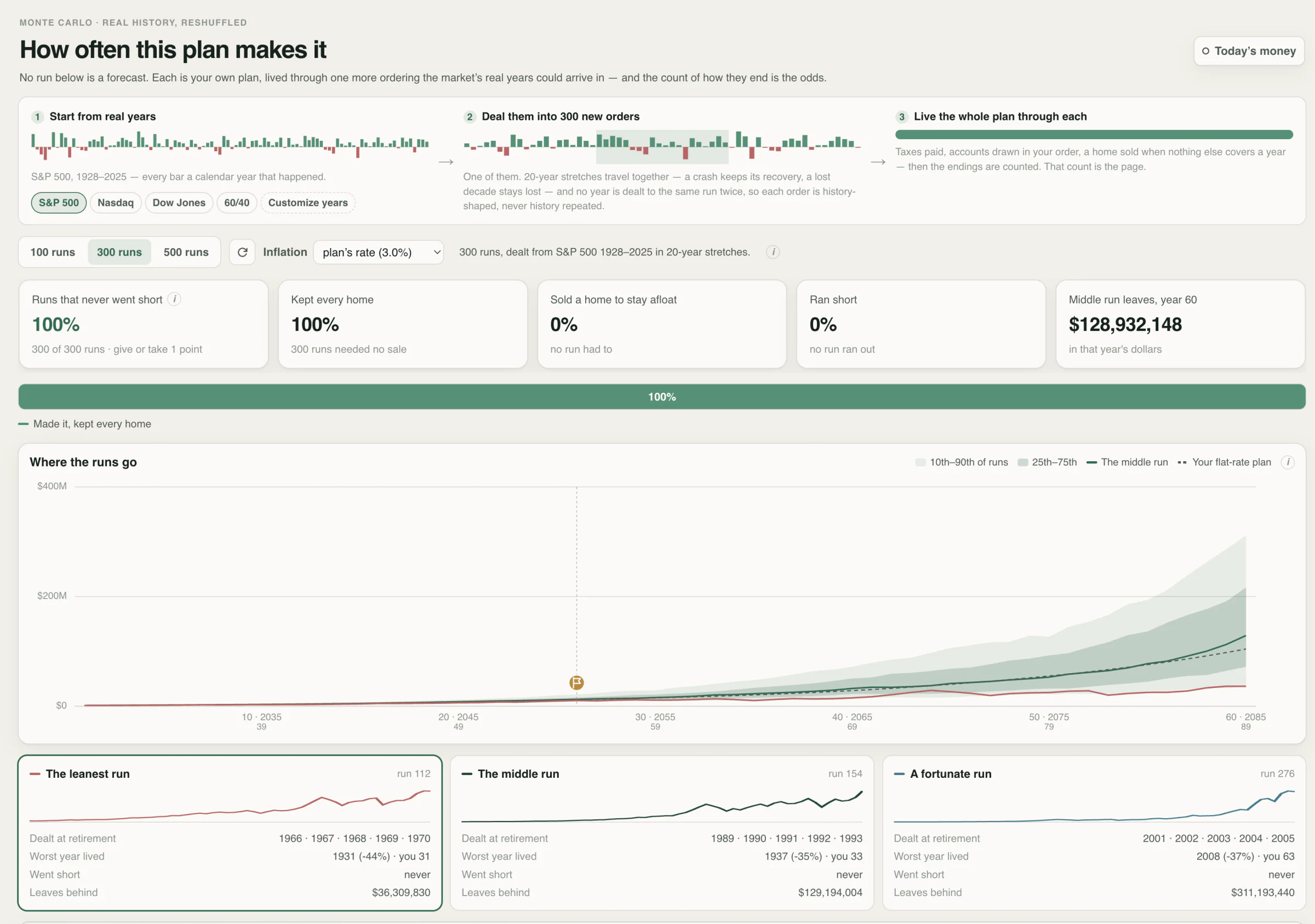
Stress-test your financial plan with historical market sequences and explore a range of possible outcomes.
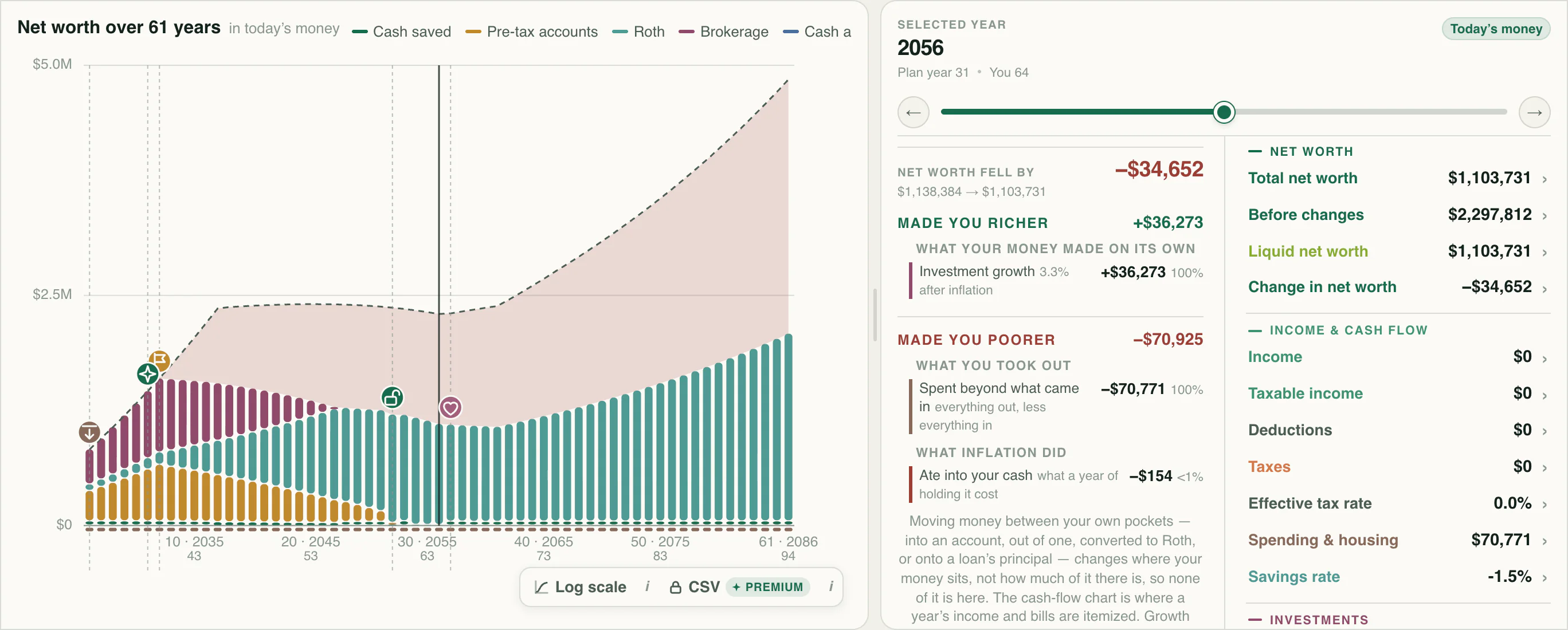
Compare financial planning scenarios for retirement dates, saving rates, career changes, and home purchases against your original forecast.
Know the language
Your next chapter
Start with your numbers. See where they could lead.